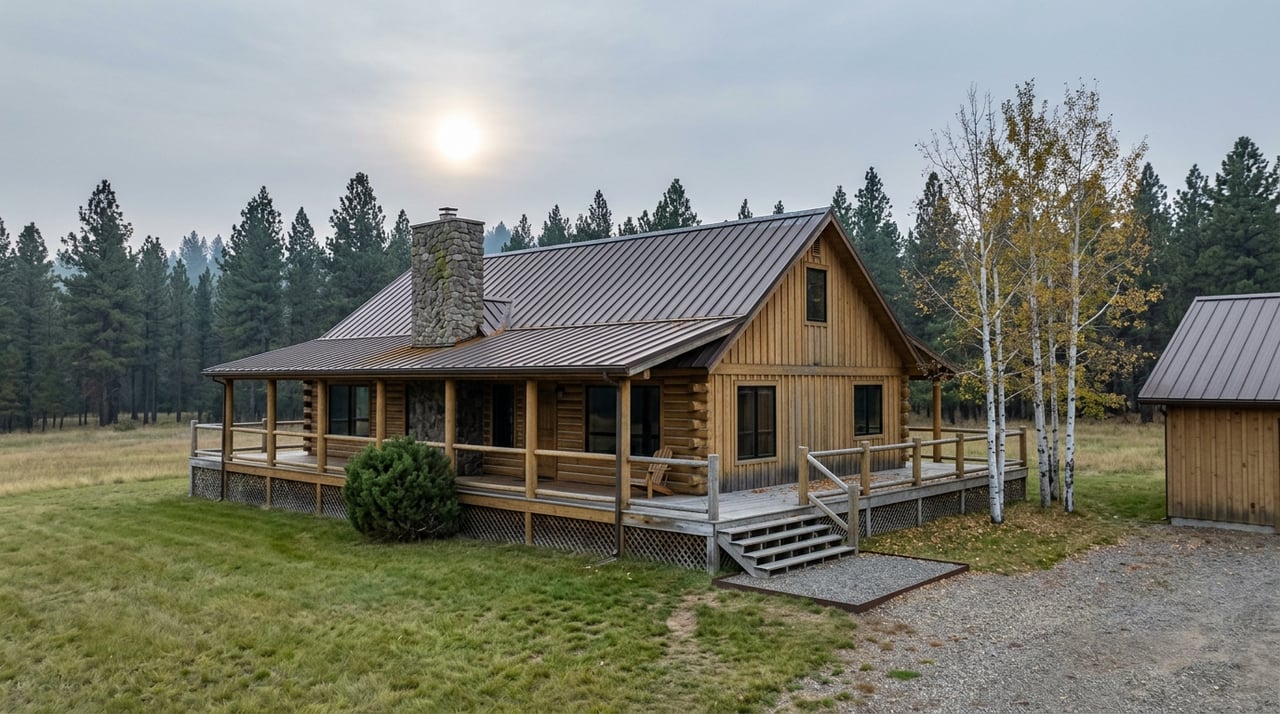
Ask most people looking at property in the Helena area why they'd choose Helena Valley or the county over a lot inside city limits, and you'll hear some version of the same answer: bigger parcel, more privacy, and lower taxes since you're not paying for city services you won't use. The first two are usually true. The third one is where the math gets more complicated than the assumption suggests.
Lewis and Clark County does not simply drop its tax rate once a property crosses out of Helena or East Helena. It restructures it. The county's own reporting on how it sets mill levies shows that the portion of your bill controlled by the county, separate from city, school, and special district mills, has actually run higher outside incorporated limits than inside them, because the county assesses additional levies for roads and planning that only apply to unincorporated property. Leaving the city doesn't remove a cost. It swaps one line item for a different one, and the swap isn't always in the buyer's favor.
The slice of the bill that works backward from expectation
Montana property tax bills are stacked, not flat. A parcel pays county mills, plus city mills if it sits inside a municipality, plus school district mills, plus whatever special districts serve it, all summed and multiplied against the parcel's taxable value. Most buyers focus on the total. Fewer look at how the county's own portion of that stack changes depending on which side of the city line the parcel falls on.
In a KTVH report on county mill levies, Lewis and Clark County's chief financial officer explained that the county lowered its mills for property inside Helena and East Helena while unincorporated property carried a meaningfully higher county mill count, specifically because the county levies additional mills for roads and planning services outside city limits. County Commissioner Tom Rolfe put it simply: "We encourage people to come by and bring their questions." The invitation stands, and it's worth taking him up on it, because this isn't a one-year quirk. It's how the formula is built. State law caps how much revenue a taxing jurisdiction can raise each year, and Lewis and Clark County recalculates its mills against that cap every September, ahead of a state reporting deadline that falls around September 11. The exact numbers move annually. The structural gap between city and unincorporated county mills doesn't, because the underlying service split doesn't change: the county still has to fund roads and planning in the areas where it, not a city government, is responsible for both.
On the city side of the ledger, Helena's own general fund levy has been trending upward too. For the fiscal year that just closed this past June, the city's finance director presented a proposed general levy of 123.64 mills, up from 110.43 mills the year before, plus a permissive health levy of 28.19 mills and a voted fire levy equivalent to roughly 11.54 mills. City residents absorb that increase in exchange for services, sewer, water, police, parks, that a Helena Valley or unincorporated county buyer is paying for differently, if at all.
The two bills town living bundles into one
Inside Helena, sewer and water are municipal utilities billed the way you'd expect: a connection, a meter, a monthly rate. Helena's public water system maintains more than 146 miles of sanitary sewer line and three lift stations that carry wastewater to treatment, according to the state's own water utility inventory. That infrastructure is baked into your city tax and utility bill whether you think about it or not.
Step outside city limits and that infrastructure mostly stops. Private septic system use continues across the Helena Valley, per the same state inventory, which means a buyer isn't just skipping a sewer bill, they're taking on the site evaluation, soil testing, drain field grading, and periodic pumping that a septic system requires. Local excavation companies that do this work regularly, including Valley Septic and Schaefer Excavating, describe jobs ranging from new custom home installs in the South Hills area to mobile home system upgrades near Lake Helena Drive to winter repair calls in East Helena. Every one of those is a cost that a city sewer connection simply absorbs into a flat utility bill.
Roads work the same way. Inside Helena or East Helena, road maintenance rides on your municipal tax bill. In the unincorporated county, some roads are maintained through Rural Improvement Districts, resident-petitioned special districts that levy an additional fee specifically to fund projects like road upkeep in that particular area. Lewis and Clark County's own list of these districts includes named examples such as the 4x4 Road District, established by county resolution to fund maintenance on that specific stretch of road. If a property sits inside one of these districts, that fee shows up as its own line on the tax bill, on top of the county's general road mills. If it doesn't, road maintenance may fall more directly on the property owner, depending on the road's classification.
None of this means unincorporated property is a bad buy. It means the savings a buyer expects from leaving city limits often gets absorbed by costs that don't show up until the septic inspection, the well flow test, or the first spring pothole season.
| Inside Helena or East Helena | Unincorporated Lewis and Clark County | |
|---|---|---|
| Sewer and water | Municipal utility, billed monthly | Private septic and well, owner-maintained |
| Road maintenance | Funded through city tax mills | County mills, sometimes plus a petitioned Rural Improvement District fee |
| County-assessed mills | Lower, per the county's own reporting | Higher, specifically for roads and planning |
| City-assessed mills | Applies (rising per the city's most recently finalized general levy) | Does not apply |
The home itself often costs more, not less
Even setting the tax structure aside, the assumption that county property is simply cheaper doesn't hold up against the actual sales data. Zillow's home value index put the average home value across Helena at $445,567 as of July 2026. In Helena Valley Northeast, an unincorporated pocket northeast of the city, the average home value was $664,455 as of August 2026, up 3.2% over the year. That's not a modest gap. A buyer moving to that specific area for more land and a lower tax mill count is often doing so at a home price nearly 50% above the citywide average, before factoring in what a septic system or a road district fee adds on top.
This is the part of the trade that rarely gets said out loud. Acreage, privacy, and a rural mailing address aren't cheap alternatives to city living around Helena. They're a different product entirely, priced on their own terms, with their own cost structure layered underneath.
What this means if you're weighing both
None of this is an argument for one side of the city line over the other. It's an argument for asking sharper questions before you write an offer, because the county assessment notice you'll eventually receive won't explain any of this context on its own. Before comparing two properties on either side of Helena's city limits, it's worth finding out:
- Whether the specific parcel sits inside a Rural Improvement District, and what that district's current fee actually is
- Whether the property is on a private septic system, how old it is, and when it was last inspected
- Whether the well has a documented flow test and what the water rights situation looks like on record
- Which fire district and school district actually serve that address, since both carry their own mills
- What the county's most recent mill-set looked like for that specific tax code area, since Lewis and Clark County publishes this detail publicly each year around the September deadline
A county assessment notice will tell you your taxable value. It won't tell you why a house eight minutes outside Helena carries a materially different cost structure than one eight minutes closer to downtown, even at a similar sale price. That's local knowledge, and it's the kind of thing that's easy to miss from a portal listing and much harder to miss once you've walked the property with someone who knows which questions the tax bill doesn't answer.
A few common questions
Does every unincorporated property in Lewis and Clark County pay the same extra road and planning mills? No. The county's own mill levy applies broadly, but Rural Improvement District fees only apply to parcels inside a petitioned district, and those vary by location and by what the district was formed to fund.
How do I find out if a property is on septic or city sewer before I make an offer? A licensed excavator or septic inspector can confirm system type, age, and condition, and county permitting records typically show whether a property was ever connected to municipal sewer. It's worth confirming this early, since it affects both your closing costs and your ongoing maintenance budget.
Do these mill differences change every year? The exact numbers do. Lewis and Clark County recalculates its mill levies annually under a state formula, with the totals typically finalized each September. The structural pattern, county mills running higher on unincorporated property to fund roads and planning that a city government would otherwise handle, has held across the years the county has reported on it in detail.
If you're weighing a lot in the Helena Valley against a house closer to downtown, or trying to figure out what a specific parcel's tax code area actually adds up to, Joszie and Jason Driear can walk the numbers with you before you write an offer, not after the assessment notice arrives.
This article is general information, not legal, tax or financial advice. Consult a qualified professional about your situation.